.jpg)

| Category: | Organic Spices |
|---|---|
| MOQ: | 1 Bottle |
| Certificate: | Testing reports |
| Uses & Application: | 1. Mogra Saffron is extensively used in gourmet cooking to enhance the flavor, aroma, and color of luxury dishes like biryani, pulao, risotto, paella, and stews. 2. It is a key ingredient in premium Indian desserts such as kheer, kesar peda, gulab jamun, |
| Packing: | 5gm |
| Packing Details: | Jar |
| Supply Capacity: | 100 |
| Port of Dispatch: | Any |
| Delivery Time (In Days): | 10 |
| Payment: | Cash on delivery,Net banking,others |
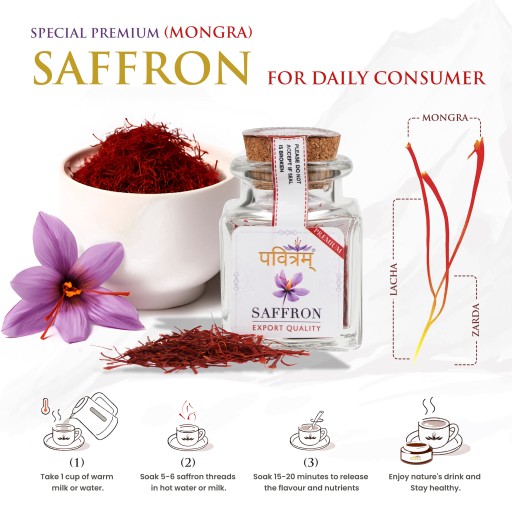
Mogra Saffron is cultivated predominantly in the Pampore region of Kashmir, often referred to as the “Saffron Town of India.” The unique climate, mineral-rich soil, and altitude provide the perfect conditions for Crocus sativus, the saffron crocus, to flourish. Unlike many crops that can be machine harvested or grown at scale, saffron requires meticulous care. Each flower blooms only once a year during a short window in autumn. And within each bloom are just three delicate stigmas — the treasure sought after by farmers and connoisseurs alike.
To produce just one kilogram of Mogra Saffron, it takes over 150,000 flowers, handpicked at dawn when the blooms are most vibrant. The stigmas are then gently separated, ensuring that only the finest part — the vivid red threads — are retained. These are sun-dried using traditional techniques that preserve their volatile oils, ensuring their intense aroma and flavor remain intact.
When one opens a jar of Mogra Saffron, the senses are immediately overwhelmed. The aroma is earthy yet floral, rich with notes of honey and hay, with a hint of bitter-sweet elegance that speaks of ancient lands and sacred rituals. Visually, Mogra saffron stands apart — the strands are long, deep crimson-red, with no yellow or white portions, signaling supreme quality. When steeped in warm milk or water, the strands release a brilliant golden hue and infuse the liquid with a fragrance that feels both comforting and luxurious.
In terms of taste, Mogra Saffron is subtly bitter with a complex flavor profile. It enhances the flavor of dishes rather than overpowering them. Its culinary value lies not just in its color, but in the depth and warmth it brings to food, blending beautifully with both sweet and savory recipes.
related products

.jpg)

.jpg)
.jpg)
.jpg)
ABOUT US
-

Kemfree.com is India’s first online start up and global platform to buy, sell, trade, import & export of hazardous chemical & pesticides free certified or non certified (lab tested) organic products that enables sustainable partners and organic farmers in connecting directly with consumers.